Ceiling and Sidewall Insulation
R-Factor Guidelines
Within the past few years, the Department of Energy has developed
new insulation guidelines. These are minimum standards. There is
absolutely nothing stopping you from installing more insulation. The
only thing you need to consider is the long-term payback. For
example, I built my home over ten years ago. At the time, the
guidelines for ceiling insulation were an R-30 in my climate zone. I
doubled that and installed an R-60 ceiling of blown-in fiberglass.
Did I waste my money? I think not. My neighbors fuel bills for
houses smaller than mine are nearly double! I save approximately
$1,000 per heating season. I probably save an additional $400 during
the cooling season. Some of these savings can be attributed to
thicker sidewall insulation, an air infiltration barrier, and tight
building practices. However, in your existing home, you might save
$150 to $200 per year on average. If it costs you only $300 more to
upgrade to an R-60 or more, do so! Within two to three years, you
will be saving money.
The U.S. Department of Energy, Office of Energy Efficiency &
Renewable Energy, has also published Technology Fact Sheets on basement
insulation; crawlspace insulation; slab insulation; wall insulation;
and ceilings & attics.
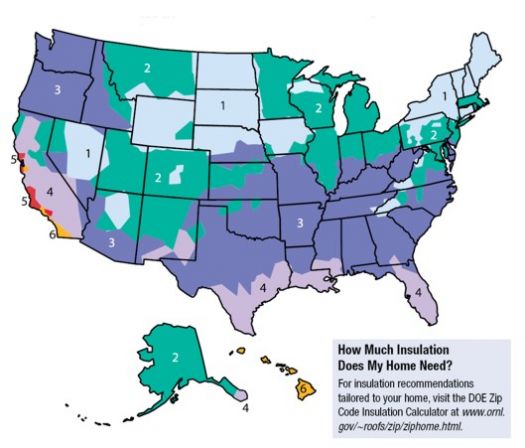
The map below is vastly different from the old guideline maps
that showed only five climate zones. If your city is located on the
borderline of one of the zones, always upgrade to the higher zone.
It will not cost that much. Ask the manufacturers for installation
guidelines. You need to learn how to do it right. Knowledge is
power!
U.S. Department of Energy Recommended* Total
R-Values
for New Houses in Six Climate Zones
 |
| PHOTO CREDIT: US
Department of Energy |
* "These recommendations are cost-effective levels of insulation
based on the best available information on local fuel and materials
costs and weather conditions. Consequently, the levels may differ
from current local building codes. In addition, the apparent
fragmentation of the recommendations is an artifact of these data
and should not be considered absolute minimum requirements." ... US
Dept. of Energy
Insulation Zone Map
Guide
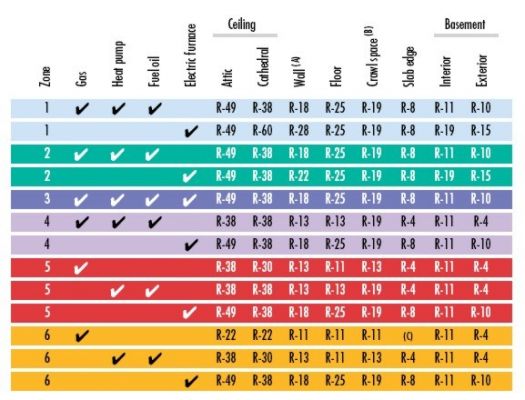
The following table shows the different R-Values that you need to
achieve in ceilings, walls and floors with respect to the zone you
live in. Study it for a few moments and it will make sense.
 |
| PHOTO CREDIT: US
Department of Energy |
(A) R-18, R-22 and R-28 exterior wall systems
can be achieved by either cavity insulation or cavity insulation
with insulating sheathing. For 2 in. x 4 in.x walls, use either
3-1/2 in. thick R-15 or 3-1/2 in. thick R-13 fiberglass insulation
with insulating sheathing. For 2 in. x 6 in. walls, use either
5-1/2 in. thick R-21 or 6-1/4 in. thick R-19 fiberglass
insulation.
(B) Insulate crawl space walls only if the
crawl space is dry all year, the floor above is not insulated, and
all ventilation to the crawl space is blocked. A vapor retarder
(e.g. 4- or 6-mil polyethylene film) should be installed on the
ground to reduce moisture migration into the crawl
space.
(C) No slab edge insulation is
recommended.
NOTE: For more information, see:
DOE Insulation Fact Sheet
(DOE/CE-0180)
U.S. Department of Energy
Technical Information
Center
P.O. Box 62
Oak Ridge, TN 37830
or Energy Savers - Tips on Saving Energy & Money at
Home from U.S. Department of Energy, Office of Energy Efficiency
and Renewable Energy.