 This Lecture is in 3 parts: Read the others
by following the links at the bottom of the
page.
This Lecture is in 3 parts: Read the others
by following the links at the bottom of the
page.ELEMENTS OF EUROPEAN ROMANTICISM
This Lecture is in 3 parts: Read the others
by following the links at the bottom of the
page.
Above all, Romanticism values the individual over the dictates of authority. Rules of any kind, including literary rules, were viewed as contrivance and not as art; as a consequence, the Romantics rebelled openly and in written form against the dictates of Neo-Classicism. An artist creates something that has not been created before, something that comes from within, something original, and normally that meant some novelty of subject matter and artistic method. Certain stock figures from Romanticism survive today, such as the alienated anti-hero (James Dean), who are descended from the so-called Byronic hero and Goethe's Werther (the prototype of the misunderstood, eccentric, obsessive, man of genius and sensibility: think of the Hippies of the 1960s). Romantics were not drawn to the eccentric for its own sake. The preoccupation with self (one more "me" generation), the exception to the rule, "proves" human nature by the seeming uniqueness of the individuals who partake in it. Thus, through the unique personality of an author, we learn something about the "norm" of human nature, and from that, the universal.
PART I:
THE ROMANTIC HERO
The Romantic Hero is often disllusioned about life, about
his hopes, his dreams. He is always seeking/longing for something
spiritual in nature that is perpetually just out of reach/the unattainable
(die Blaue Blume [symbolized as "the blue flower" in Germany], reu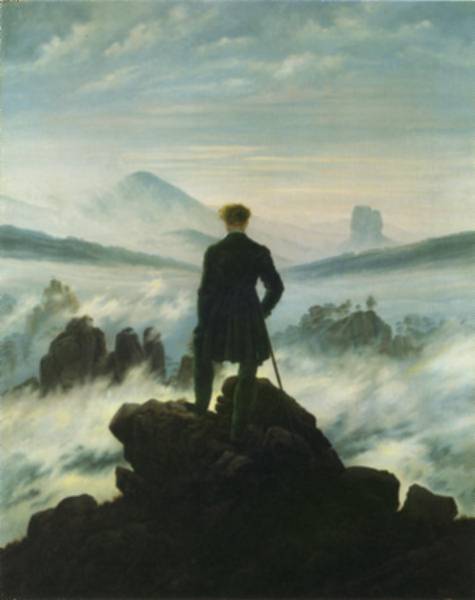 nification of the masculine feminine principals, union with the
infinite/the eternal). He is often at odds with society, and is usually
alienated from it (if not an actual recluse). He is the prototype in
literature of the "outsider," seen for example as late as the early 20th century
in works of Hermann Hesse's like Rosshalde, Demian, The Steppenwolf,
Siddhartha, and others. He often, through his disillusionment with
life, becomes a victim of what the French have called ennui. It
is a kind of disenchanted boredom with life in general with elements of cynicism
and depression. Ennui is at times connected to
Weltschmerz: a German word for an almost inexplicable melancholy which
includes hope while at the same time recognizing the futility of hope.
Weltschmerz, in turn, often led to nihilism, a term often
credited to the great German philosopher, Friederich Nietzsche, but more likely
first coined in literature by the Russian author, Turgenev (extracted from his
novel, Fathers and Sons: "Bazarov, the Nihilist"). Elements of
Nihilism, however, were already present long before Turgenev and
Nietzsche used the term, in the works of many of the early Russian Romantics:
Alexander Pushkin, Nikolai Gogol, and Mikhail Lermontov, for example.
Nihilism is self-defining: it believes in nothing, but wants to believe in
everything. It is the gloomy sense of the meaninglessness of existence
that is a forerunner of French Naturalism and Existentialism.
nification of the masculine feminine principals, union with the
infinite/the eternal). He is often at odds with society, and is usually
alienated from it (if not an actual recluse). He is the prototype in
literature of the "outsider," seen for example as late as the early 20th century
in works of Hermann Hesse's like Rosshalde, Demian, The Steppenwolf,
Siddhartha, and others. He often, through his disillusionment with
life, becomes a victim of what the French have called ennui. It
is a kind of disenchanted boredom with life in general with elements of cynicism
and depression. Ennui is at times connected to
Weltschmerz: a German word for an almost inexplicable melancholy which
includes hope while at the same time recognizing the futility of hope.
Weltschmerz, in turn, often led to nihilism, a term often
credited to the great German philosopher, Friederich Nietzsche, but more likely
first coined in literature by the Russian author, Turgenev (extracted from his
novel, Fathers and Sons: "Bazarov, the Nihilist"). Elements of
Nihilism, however, were already present long before Turgenev and
Nietzsche used the term, in the works of many of the early Russian Romantics:
Alexander Pushkin, Nikolai Gogol, and Mikhail Lermontov, for example.
Nihilism is self-defining: it believes in nothing, but wants to believe in
everything. It is the gloomy sense of the meaninglessness of existence
that is a forerunner of French Naturalism and Existentialism.
The Romantic Hero is a man of extremes--no limitations are placed upon imagination or feelings. The more powerful the feelings, the better. In his love relationships, he is obsessive, and he often makes the connection between (the feminine principal in) Nature and the object (usually unrequited) of his affections. At times, it seems he does not distinguish between Nature and the woman herself. Thus, the attempt for the spiritual, symbolic union of masculine and feminine (but the idea is physical as well). And as is the case symbolically, the physical union usually meets with disillusionment and disappointment. In some cases, the result is suicide. Again, this type of character will remain throughout European literature in both male and female form, even in the late 19th century writings of such great Russian, German, and Scandinavian authors as Dostoevski, Tolstoy, Mann, Hesse, Knut Hamsun, Heinrich Ibsen and others. Clearly, Romantic Heros are not everyday types. You won't normally live next door to one or meet one on the street. They are highly individualized, egocentric, obsessive, creatures, who lean toward the autobiographical and confessional in their writings. It is not likely that you will run into Chateaubriand's Rene at the next PTA meeting.
In sum, the Romantic Hero is subject to flights of imagination, dreaminess, hallucinations. Many, many tears and a great deal of personal woe are common, as are suicidal tendencies, and other tendencies to escape this frustrating world (religion or religious seclusion for example. There were a lot of conversions to Catholicism among the Romantics). Although the Romantic Hero often displays a kind of innocence and naivete, he is neverthless entirely wrapped up in himself and his own problems. He is not much interested in authority, objectivity, or conformity. He indulges, if not wallows in, his own feelings, sentiments, uniqueness, intuitiveness. His subconscious will take precedence over reason, objectivity, the typical. We often see a way out for the Romantic Hero, and oftentimes become exasperated at what seems to be the lack of initiative, the spinelessness, the masochism of remaining in painful situations that could be ended by an act of average courage. The advice given to Werther (Goethe's Die Leiden des Jungen Werthers: The Sorrows of Young Werther) sums up this exasperation adequately when Werther is told to "Be a man!"
III. ROMANTICISM AND THE IMPORTANCE OF EMOTIONS/FEELINGS